
Inflammation and Lifestyle Patient Education for Your Clinic
By: Carolyn Vandyken, BHSc (PT), CredMDT, CCMA ∙ Estimated reading time: 3 minutes
By: Carolyn Vandyken, BHSc (PT), CredMDT, CCMA ∙ Estimated reading time: 3 minutes
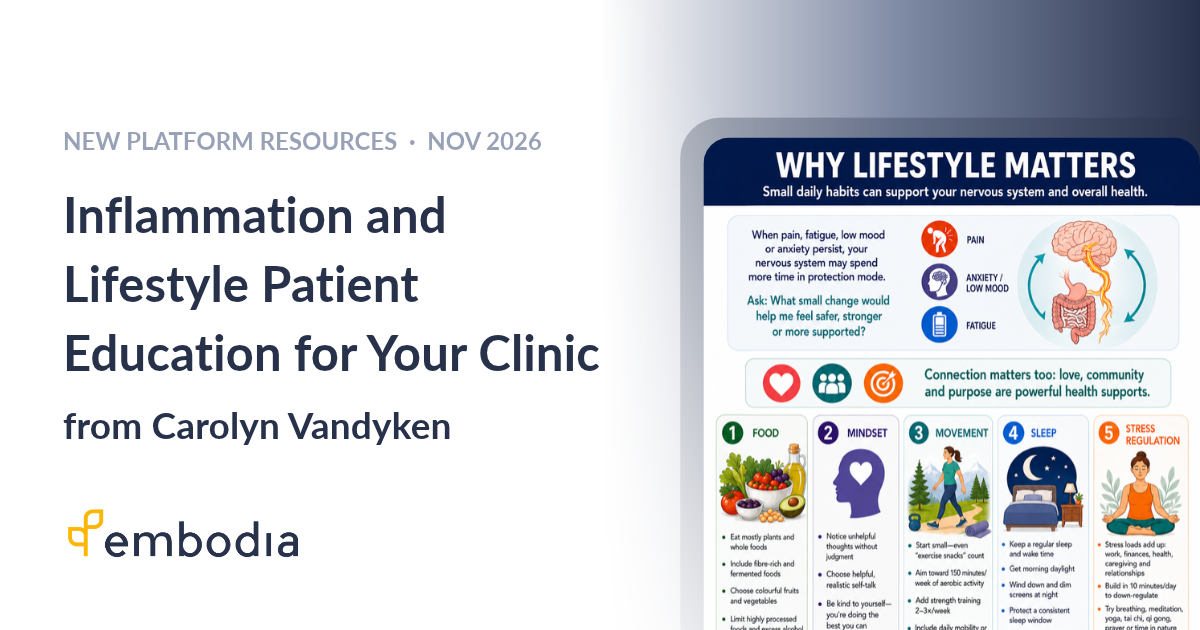
New Inflammation and Lifestyle Education by Carolyn Vandyken
Your patient with persistent pain lists more than their main complaint. They're tired no matter how much they rest, their digestion is off, they sleep poorly, and their mood has dipped. They ask you, half joking, whether it's all connected.
It's a fair question, and a good opening. Chronic low-grade inflammation is one way to help patients see how sleep, food, movement, and stress fit together. It also shows them what they can change between sessions.
Embodia's patient education library now includes a new collection of inflammation and lifestyle resources created by Carolyn Vandyken, BHSc (PT), CredMDT, CCMA, of Reframe Rehab. Each one turns a big idea into small, practical daily steps.
Why Inflammation Education Belongs in Rehab
Many of your patients already suspect that their fatigue, sleep, digestion, and pain are linked. What they usually lack is a clear, hopeful explanation and a place to start.
This collection gives them both. It frames inflammation as something they can influence rather than something that happens to them, and it avoids blame along the way. As The Inflammation Connection puts it, inflammation is not your fault, but it is something you can influence.
The framing matters in practice. When patients see lifestyle changes as part of their recovery, the conversation shifts from "extra homework" to "part of my plan." The advice in these resources lines up with what you're already recommending: move more, sleep better, manage stress, and eat mostly whole foods.
What's in the Collection
The Big Picture
- The Inflammation Connection: introduces chronic low-grade inflammation, lists common signs such as fatigue, brain fog, aches, poor sleep, and low mood, and shows patients that daily habits can calm the fire.
- Why Lifestyle Matters: explains how pain, fatigue, and low mood can keep the nervous system in protection mode, then covers five areas: food, mindset, movement, sleep, and stress regulation.
The Numbered Anti-Inflammatory Series
These six resources are designed to be used in order, from understanding to daily action.
- The Inflammation Connection (above)
- Dr. Christina Miller's Ginger Strategy: simple ways to add ginger daily, a starter amount, and a 2-minute ginger dressing.
- The Hyper-Nourishing Smoothie Protocol: a five-step smoothie formula built around leafy greens, omega-3 seeds, berries, and fruit, with an example recipe.
- Green Tea & Environmental Inflammation: how green tea fits into a daily routine, alongside practical ways to reduce exposure to environmental irritants.
- Feed Your Microbiome to Improve Gut Health: already in the library, and the gut health piece of the series.
- Your Daily Anti-Inflammatory Action Plan: a printable weekly checklist with space for goals, a daily focus, and notes on wins.
Eating and Moving Well
- Mediterranean Diet to Decrease Inflammation: a plate model, foods to eat more and less often, and small swaps that fit any culture, budget, or medical need.
- Walking for Cardiovascular Health: based on Dr. Mike Evans' video "23 and 1/2 hours," with realistic weekly targets and easy ways to add more walking.
How to Use It With Your Patients
At assessment. When a patient describes several overlapping symptoms, share The Inflammation Connection or Why Lifestyle Matters. Both open the door to a whole-person conversation without overwhelming them.
As a homework companion. Your Daily Anti-Inflammatory Action Plan works well next to your exercise program. Ask your patient to bring it back so you can review their wins together.
When your patient wants something concrete. The Mediterranean Diet, Smoothie Protocol, and Ginger resources give clear, food-first starting points. They also make it easy to refer on to a dietitian when needed.
For deconditioned or sedentary patients. Walking for Cardiovascular Health reassures patients that brisk walking is enough, and that the biggest gain comes from going from inactive to active.
You can share each resource directly with your patients through Embodia, so they have it on hand between sessions.
Finding the New Resources on Embodia
All of these resources are available now in Embodia's patient education library for Tier 2 and Tier 3 members, ready to share with your patients.
Looking for the nervous system side of the story? Read our companion post, Nervous System and Stress Patient Education for Your Clinic.
Want to go deeper with Carolyn? Her Year of Mentorship program builds the clinical reasoning behind this whole-person approach.
Register for year of Mentorship 2027
---
Date written: 4 Nov 2026
Last update: 13 Nov 2026

BHSc (PT), CredMDT, CCMA
Carolyn is the co-owner of Reframe Rehab, a teaching company engaged in breaking down the barriers internationally between pelvic health, orthopaedics and pain science. Carolyn has practiced in orthopaedics and pelvic health for the past 37 years. She is a McKenzie Credentialled physiotherapist (1999), certified in acupuncture (2002), and obtained a certificate in Cognitive Behavioural Therapy (CBT) in 2017.
Carolyn received the YWCA Women of Distinction award (2004) and the distinguished Education Award from the OPA (2015). Carolyn was recently awarded the Medal of Distinction from the Canadian Physiotherapy Association in 2021 for her work in pelvic health and pain science.
Carolyn has been heavily involved in post-graduate pelvic health education, research in lumbopelvic pain, speaking at numerous international conferences and writing books and chapters for the past twenty years in pelvic health, orthopaedics and pain science.