
Overcoming Plateaus in Male Pelvic Pain
Overcoming Plateaus in Male Pelvic Pain
This course includes
The instructors
Overview
Many clinicians working with male pelvic pain patients hit a familiar wall. Pain improves by 30% but won't budge further, symptoms migrate unpredictably, or conventional pelvic floor interventions stop working. The patient is better, but not better enough, and you're left wondering whether you've missed something.
In many of these cases, the plateau isn't a treatment dosage problem. It's a targeting problem.
The spine is one of the most overlooked drivers of male pelvic pain, and when it's the true source, pelvic floor work may produce partial gains but will never close the remaining gap.
This course teaches clinicians how to identify when the spine is driving pelvic pain and how to apply the right spinal interventions to break through the plateau. Participants will learn to recognize changing pain locations, postural and movement sensitivities, and directional preferences, and leave with strategies they can apply in their next session.
Learning Objectives
By the end of this course, participants will be able to:
- Screen for spinal drivers in male pelvic pain patients who have plateaued
- Understand the focused spine assessment
- Integrate spinal interventions
- Understand the practical baseline measures
About the Presenter: Dr. Di (Woody) Wu

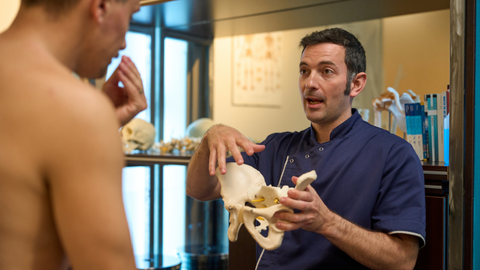
Dr. Di Wu is trained as a medical doctor and completed his residency in Beijing. He practiced as an Orthopedic Surgeon for several years, before establishing himself in Montreal, Canada. In Montreal, he attended physical therapy school at McGill University where he was the first man to enroll in the pelvic floor course. He adapted his learning from that course, which solely focused on women, to be able to effectively treat men.
Over the past decade, drawing inspiration from his background as a doctor and as a PT, he has built a framework to help him get repeatable and reliable treatment results for treating male pelvic pain. After almost a decade of refinement and conducting studies to corroborate the findings, Di has solidified the framework. He now shares his knowledge and passion about male pelvic pain nationally and internationally with PTs who are interested in treating male pelvic pain.
The instructors


Pelvic and Reproductive Health Division (formerly Women's Health Division) is a not-for-profit division of the Canadian Physiotherapy Association (CPA) that is managed, operated, and advanced by volunteers with a passion for women’s health. We are a dynamic organization, national in scope, that effectively facilitates communication, education and service delivery for physiotherapy practitioners on topics specific to women’s health.
Our mission is to provide leadership and direction to members of the CPA for the advancement of physiotherapy practice in women’s health by fostering excellence in practice, education, and research for the benefit of Canadians.
We aim to:
- Acquire and make available information and educational materials
- Encourage and develop the publication of research in the field
- Facilitate communication between and among members
- Promote ongoing professional development
- Enhance physiotherapy service delivery specific to women’s health and/or pelvic health.
Material included in this course
-
Course Materials
-
Welcome
-
Full presentation
-
Feedback
Is a certificate of completion included with this course?
Once you have completed the course, a certificate of completion (including learning hours and course information) will be generated. You can download this certificate at any time. To learn more about course certificates on Embodia please visit this guide.
This can be used for continuing education credits, depending on your professional college or association. If this course has been approved for CEUs in specific jurisdictions, it will be noted on the course page and CEU information may be added to your course certificate. Please read this guide for more information.
I'm a member of the Canadian Physiotherapy Association (CPA). What are the discounts available to CPA Members on Embodia?
As part of our partnership with the CPA, we offer its members discounts on courses and Embodia Memberships. Learn more about the partnership on this page.
In order for the discount to be applied, you first need to authenticate your CPA membership. This is an important step as this is how Embodia 'knows' that you are a CPA member.
To authenticate as a CPA member, please visit this page on the CPA portal.
Please note that your email address on your CPA account must match your email address on Embodia. If needed, you can update your information on Embodia as outlined in this guide.